Quality Assured
Worldwide Shipping
Expert Support
Chloride Ion Penetration Meter
Description & Specification
Chloride Ion Penetration Meter
Categories:
Concrete Testing Equipment
Technical Specifications
The test is performed applying a voltage difference between the ends of a cylindrical specimen, one end is the negative and is immersed in a sodium chloride solution, the other is the positive and is in a sodium hydroxide solution.
This test method allows concrete to be evaluated in terms of chloride permeability, this parameter is essential as it influences concrete durability.
Main Features:
Programmable test duration and adjustable measuring rate starting from 1 minute
Continuously variable voltage difference from 5 to 70 VDC independent for each channel
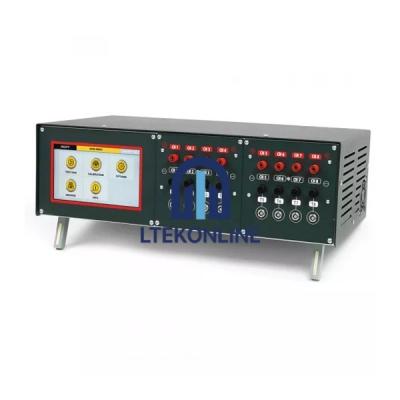
Double version: model with 4 or 8 independent channels
Wide touch screen color display
Unlimited data storage on internal 8 GB memory.
Technical Specifications:
4 or 8 specimens simultaneous testing (see the models)
Each channel is independent
Continuous current measurement with accuracy +/- 1 mA, resolution 0.1 mA
Continuous temperature measurement with PT100 probe, accuracy +/- 1°C, resolution 0.1°C
Programmable test duration
Testing data displayed in numerical and graphical mode
7” color display with capacitive touchscreen
8 GB internal memory
Adjustable sampling rate (starting from 1 minute)
Continuously variable voltage difference from 5 to 70 VDC independent for each channel.
Voltage accuracy better than +/- 0.1V, resolution 0.01 V
Friendly interface with pre-set test routines to the main Standards plus custom procedures.
RS 232 serial port for PC or serial printer connection
USB port for data export/storage on external memory (USB pen drive)
LAN port for PC connection.
Dimensions and weights:
Instrument: (l x w x h) 503 x 330 x 164 mm, 11.5 kg
Cell: (l x w x h) 200 x 150 x 150 mm, 3.5 kg
Cell: (l x w x h) 350 x 150 x 150 mm, 5 kg
Migration set up kit: (l x w x h) 380x270x280 mm, 10 kg.